Wool Handling Rules

These rules will apply at all (SSAA) affiliated competitions and events.

Developed and run in accordance with the current Australian Wool Exchange (AWEX) Code of Practice for the Preparation of Australian Wool Clip.

These rules are current  to the 2025-2027 edition of Australian Wool Exchange (AWEX) Code of Practice.

These rules are current from - 24th of October 2025

Interpretation

In these Rules unless the context otherwise requires:

  1. Words implying the masculine gender will include the feminine as the context fits.
  2. Words implying singular will include the plural as the context fits.

Penalties & Points

    1. Do not confuse penalty strokes with points.
    2. A penalty stroke is subject to further calculation (i.e. addition and division)
    3. A point is subject only to inclusion and addition to the score.
  1. Entries will be in the format required by the organizing committee.
  2. Late entries may be accepted at the organising committee’s discretion and may incur a surcharge.
  3. The organising committee may reject any application for late entries if the maximum number of wool handlers required for competition in any class has been filled.
  4. Organising committees are encouraged to offer team and feature events specific to their program but should continue to observe all rules and regulations relevant to the conduct of SSAA competitions.

Note. These are National rules and apply at the State, National and World Championships when held in Australia.

Competitor’s will be graded as:

4.  NOVICE

a. For inexperienced wool handlers or wool handlers who have not competed in a show.

b. If the individual’s ability is deemed to be higher by the head wool judge, the competitor must upgrade, at next their competition.

c. If you are a qualified Wool Classer and there is no senior event, the competitor may enter this class, if the head wool judge of the competition deems your ability to be that of a novice otherwise you must compete in the open event.

d. If the competitor wins four (4) novice events they must be upgraded.


5. SENIOR

The senior event is for experienced wool handlers / wool classers and people who have upgraded from the novice. (Not all shows have a senior event)

a. If there is a senior event, all qualified Wool Classers and non-Open wool handlers must compete in this class.

b. If you have upgraded from novice.

c. If the competitor is a novice, and they place first (1st) in a senior event , they remain a senior competitor.

d. If the competitor wins four (4) senior events, they must upgrade to the open grade.


6.  OPEN

a. Anyone wishing to enter the event.

b. If they are a novice or senior competitor and have placed first (1st) in an open event they remain an open competitor.


  1. Competitor’s must abide by the rules and guidelines of Sports Shear Australia Association Inc. (SSAA) and their SSAA state bodies.
  2. Competitors enter and compete at their own risk.
  3. Competitors must ensure their nomination is received prior to the closing date or risk exclusion from the competition or risk incurring a surcharge upon nominating.
  4. It is the competitor's responsibility to locate and report to the briefing area prior to the start of the competition.
  5. Competitors must report to the marshaling area at least thirty (30) minutes prior to the start of their event.
  6. Competitors must be suitably attired, which includes enclosed footwear for all competitions, prize presentation(s) and official functions. Caps, hats, earphones, headphones and Ipods must not be worn whilst competing. The referee will administer this ruling.
  7. The use of performance enhancing drugs, drips or oxygen is banned in all competitions. Competitors must not be under influence of alcohol.
  8. Random drug tests may be taken and if the test returns positive, the competitor will pay all costs and be disqualified for twelve (12) months from the date of the tests.
  9. Competitor’s must provide their own broom/paddle X one (1) and board sweep X one (1).
  10. The organising committee will oversee a draw to determine heats and stands before the start of the event. Competitors must accept the draw.
  11. The chief wool handling judge will oversee a draw in all finals.
  12. Wool handlers may designate which order their finals sheep are to be shorn.
  13. Any competitor who is not present for the presentation of prizes, and is due to receive the prize, will not receive the prize unless reasonable grounds for being absent are given to the committee before the prize giving.
  14. During competitions, Competitor’s must have one foot on the floor at all times, when at the shearing board and the wool table. (Infringement will incur five (5) points, per occurrence)
  15. If a competitor sees black wool, they will remove this and hand to board judge.
  16. Wool handlers may not assist the shearers by feeding the fleece unless they are competing in a team’s event.
  17. Shearers must not help or hinder wool handlers in any way. Unless in a team’s event where they are working together.
  18. On completion of the wool handling event each competitor will remain at their table until the last competitor or the board has finished.If any competitor fails to do so they will incur five (5) points. Unless:  
    i. The competitor needs to seek urgent medical attention. 
                                                 
     ii. The competitor has been granted permission to leave the table/board area by the chief judge or referee prior to the commencement of such heat or final.
  19. All finalists will receive a printout of the final results if the facility is available.
  20. Competitors will be disqualified for conduct deemed by the chief judge, referee, or the relevant committee, to be detrimental to SSAA. EG deliberate injury to a sheep, abusive language, not conducting themselves in a manner appropriate to a sportsperson, or competing under the influence of drugs or alcohol.
  21. Disqualified Competitor’s will receive no prize or prize money.
  22. In the event of equal scores, the competitor or team with the lowest quality points wins.
  23. Competition organisers may permit wool handling competitor’s to practice during the shearing heats.
  24. No skirting of PCS on the board.
  25. If a shearer cuts themselves or blood from the shearer can be seen, the wool handler must stop competing and the head wool judge called.
  26. If a wool handler is cut or blood from that wool handler can be seen, the wool handler must stop competing and seek first aid.                                                                                       
     i. A wool handler who has stopped competing due to the blood rule will not have their points calculated and organisers will offer another heat to compete in where sheep numbers allow and at head judge’s discretion. Where possible an average score may be calculated.                                                               
    ii. Any wool that has human blood must be treated as a biohazard and carefully isolated

Note. Where possible a standard board height from stage to floor of approximately 760mm should be used. The board width should be a minimum of 1600mm.

When running a shearing and wool handling competition we are also putting on an exhibition for the general public. It is in the wool industry’s best interests that handling of all wool is done in a professional manner.

  1. A good floor for sweeping is required. Floor space for Competitor’s should be marked and roped off from spectators.
  2. A section of floor will be roped off for the judging of fleeces and oddments.
  3. Wool handling tables are preferred to be rectangular. Round tables may be used if no other options available. All tables must be the same dimensions for that event.
  4. Finals may be run with two heats if the need arises.
  5. A wool table for the fleece judges and some good-sized tables for the oddments judges.
  6. Containers: for oddments and fleece wool. Each set must be identified with different colours or numbered corresponding with table identification.
  7. For efficiency it is recommended that two (2) or three (3) sets of containers are used per table. While one set is being judged the second set of containers must be large enough to hold the required oddments. EG wool packs, Gubba bags, boxes or baskets maybe used as containers
  8. Oddments are - PCS, LKS, BLS, STN, SKN, SHK, JWL, DAG and any other lines relevant to the AWEX Code of Practice for the Preparation of Australian Wool Clips...
  9. Counters: Must be supplied for the floor Judges, (one (1) counter per table that is colour matched to a table and set of oddment containers) and checked for accuracy.
  10. Score sheets/boards, judging grids, pens, texts, judges white coats, name tags must be supplied.
  11. Wool packs and holders to be supplied for oddments and fleeces,
  12. Sufficient wool runners are required to maintain a smooth flow of fleeces from the tables to the fleece Judge
  13. Paddles /brooms and raised board sweeps should be kept on hand for general tidy up.
  14. Water coolers/bottles should be supplied for judges and volunteers.
  1. Sheep must be consistent, for breed, wool type and preparation.
  2. Type of sheep/wool - EG strong, medium or fine merino, crossbreds, prem wool or Lambs.
  3. They do not have to be crutched. There may be more than one breed shorn together (simulating what may take place in the shed) as long as the wool is kept separate.
  4.   Number of sheep in each event;                                                                                                                                                                  i. Novice two (2) to three (3), senior three (3) to four (4), Open four (4) to six (6)                                                                      ii. National semifinals three (3) to four (4); National finals four (4) to six (6).                                                                           iii. State teams six (6) to ten (10).                                                                                                                                                            iv. International teams challenge six (6) to twelve (12).


  1. The person who will organise the sheep for each event.
  2. Sheep Handler(s) program: Handlers must be aware of number of events, number of sheep needed for each event and approximate time of events.
  3. Number of sheep for the finals must be finalised well before all finals are set to run, this is to be organised by the show committee and the chief judge. The chief judge may select the competitor’s final sheep (out of what has been made available for the event).
  1. Shearers are to be selected to shear for the wool handlers prior to the events.
  2. Shearers must be selected for all wool handling finals before the event.
  3. Shearers must be of similar quality, speed and style.
  4. The speed that the pace shearers shear at will be dictated by the head judge such that the speed is increased between grades, and from heats to finals.
  5. At the completion of shearing in all wool handling events, down tubes are to be left hanging in their natural position. Unless in a teams event.
  6. Shearers are not to have a catcher in the pen if shearing and wool handling is running in conjunction / together. The shearer may have a pen mate who prevents sheep from escaping for the purpose of safety.
  1. A Chief Judge (Wool Handling) will be appointed for each competition.
  2. A Chief Judge may appoint one or more Referees for a specific event EG board or oddments.
  3. The Chief Judge will be on the disputes committee.
  4. The Chief Judge will be responsible for the administration and control of the competition strictly according to SSAA Inc. wool handling rules and guidelines,
  5. The Chief Judge has the right to disqualify any competitor whose work or conduct is detrimental to the good conduct and reputation of the SSAA competition.
  6. The Chief Judge will brief officials as to their duties with respect to the competition including:                                              i. The need to remain alert and focused in their role as judge.                                                                                                      ii.  Officials must be aware of when the fleeces are to be removed for judging.
  7. Prior to the commencement of any competition heats, all the competition rules must be available to the Competitor’s, and the Chief Judge must be available to answer any queries.
  8. Any person may seek clarification on any point from the Chief Judge. The Chief Judge may rule on the matter raised or refer it to the disputes committee.
  9. The Chief Judge may select the finals sheep from the mob that has been made available for the event.
  10. The Chief Judge will be responsible for deciding and/or displaying the lines of wool on the day, and communicating this to the competitors
  11. The Chief Judge will ensure that the oddment and fleece judges strictly adhere to the current SSAA wool handling rules.
  12. The Chief Judge for an event will draw up the roster and place the judges.
  13. The Chief Judge is responsible for setting up a briefing:                                                                                                                         i. To all other judges before the events start.                                                                                                                                  ii. To ensure consistency, accuracy, and understanding of the rules and to give judges confidence in all aspects of judging.                                                                                                                                                                                                       iii. Competitor’s briefing: to explain the lines to be made on the day etc. EG Poster with lines or display.


a.     Should have prior knowledge of  current SSAA wool handling  rules.

b.     A competitor may judge at a competition where they are  competing, but not in the class in which  they are competing.

c.      Judges must report to entry desk or chief judge twenty (20) minutes before the first event they are required to judge.

d.     Judges must be appropriately dressed: Back judges preferably wearing a white coat and board judges wearing a uniform shirt.

e.     Judges are not permitted to judge while under the influence of drugs, alcohol or smoking or vaping while judging.

f.        The Chief Judge has the right to stop the wool handler or disqualify any competitor whose work or conduct is detrimental to Wool Handling Competitions.

g.      At the start of every heat or final, judges must ensure the counters are zeroed. The change judge or Chief Judge is responsible to check and remind floor judges.

h.       If required, the Chief Judge will have the final say on all decisions re: dog bites, yoke boils, dermatitis, black wool, fly, wool rot, water stain, and any other abnormalities that may arise.

i.         Wool handling judges are not to hinder wool handlers.

j.        Wool handling judges may answer relevant questions that maybe asked by competitors.

k.      If a shearer cuts themselves or blood from the shearer can be seen, the wool handler must stop competing and the head wool judge called.

l.        If a wool handler is cut or blood from that wool handler can be seen, the wool handler must stop competing and seek first aid.                                                                                                                                                                                                                   i. A wool handler who has stopped competing due to the blood rule will not have their  points calculated and organisers will offer another heat to compete in where sheep numbers allow and at head judge’s discretion. Where possible an average score may be calculated.                                                                                                                                                           ii. Any wool that has human blood must be treated as a biohazard and carefully isolated.


  1. Stop watches - 1 or 2 competitors per timekeeper, one watch per competitor. Watches must be identified with each table e.g. Table1, Watch1, Table 2, Watch 2, or a clock board may be used.
  2. Program - information needed.
  3. Timing Starts when Shearer pulls out of gear or when the fleece becomes available on the last sheep and stops when the woolhandler places the paddle on the table.
    1.  The time is - 1 point per 10 seconds.
  4. In a teams event the time is taken from the time the shearer starts to the time the woolhandler puts the paddle on the table.
    1.  The time is - 1 point per 10 seconds.
  5. Timekeepers must be provided with: Time and/or order of events, number of sheep to be shorn in each event; number of heats and Competitor’s in each heat approximately (names not necessary).
  1. A disputes committee will be appointed and the member’s names displayed during the competition. The committee will consist of the Chief Judge, one experienced committee member, and one other person with knowledge of the rules.
  2. In the event of a dispute or appeal that relates in any way to the procedure adopted for the judging of a staging of the event, the matter will be handled expeditiously by the Disputes Committee.
  3. An appeal to the Disputes committee.
    1.  May be required in writing
    2. Will be accompanied by a $50 fee
    3.  Must be made within 10 minutes of the results being displayed and the awareness of the need for such appeal
  4. Person/s appealing may represent them selves before the Disputes Committee.
  5. In all cases, and in any matters not covered by the rules, the decision of the Disputes Committee will be final and binding on competitors.
  6. If appeal is upheld, $50 fee will be refunded.
  7. Video/Photographic evidence will not be admissible in disputes.
  1. To be eligible to Manage, judge or compete for a state, at National level or to represent Australia, the person /competitor must be an Australian Citizen and a resident in the state they are representing prior to their state selection, prior to the National event.
  2. Competitor’s must provide proof of Australian citizenship if requested by SSAA state committee, the disputes committee or National executive.
  3. Competitors in the National Championships must be prepared to represent Australia here and/or overseas and be prepared to meet any sponsorship obligations where possible and practicable.
  4. Two (2) or three (3) representatives from each state are eligible to compete in the Nationals.
  5. Competitors can only seek to represent one state in any given year.
  6. There will be six (6) competitors in the National Wool handling final.
  7. Where possible, one competitor from each state shall compete in each semifinal.
  8. A competitor has the right to contest the National Final, but if unable to represent Australia, their position in the team will go to the next highest scoring competitor in that event.
  9. The ‘State Wool Handling Challenge ‘consists of two wool handlers using one (1) table and handling wool from two (2) shearers. The shearers are not part of the team.
  10. The ‘State Team Challenge ‘consists of two wool handlers using one (1) table and handling wool from two (2) shearers. The shearers are part of the team and may assist the wool handlers
  11. The National wool handling final may be either two shearers per wool handler OR include a breed/wool type change.
  1. Time penalties: -
    1. Over the table = one (1) point per ten (10) seconds.
    2. Over the Board = one (1) point per five (5) seconds EG prem/lambs sorted on the board
    3. Mixed Breeds = one (1) point per ten (10) seconds
  2. Scoring will be by demerit point system: with the lowest points (score) is the winner.
  3. Timing of the wool handling events shall commence when each shearer has pulled out of gear or when the fleece becomes available, on the final sheep; and will end when the wool handler places their broom/paddle on their table to signify a completed job.
  4. Each competitor’s points will be calculated and recorded regardless of whether they have scored excessive quality points or have a slow time.
  5. Organising committees should provide a clock that is visible to Competitor’s and spectators.
  6. An organising committee may formulate additional rules to apply to a specific event (EG local prize, mixed sheep in a multi-breed event, novelty event rules regarding entries.)
  1. The size of a 30cm by 21cm rectangle. (A4)      (For position of fleece on the table)             = 1 Penalty (A4)
  2. The size of a 15cm by 10cm rectangle. (REC)         (For PCS and other fleece types)             = 2 Penalty (REC)
  3. The size of a 8cm by 5cm. (Credit Card))      (For LKS, Fibs and short crutch wool)             = 2 Penalty (CC)
  4. The size of a 8cm by 5cm. (Credit Card)  (For STN, Skin, Shanks, Dags, Black Wool)         = 10 Penalties (CC)
  5. Final presentation of rolled fleece FLC must be rolled not gathered, breech to neck, and placed neatly within the “designated area” (Floor, Pack, Gubba Bag, or receptacle)                                                          = 5 Penalties (max)
  6. Belly left on the board. (Belly must be cleared before woolhandlers returns to table)           = 5 Penalties
  7. The use of the fleece to clear away locks on the board.                                                                  = 5 Penalties
  8. Leaving the fleece on the board unattended.                                                                                    = 5 Penalties
  9. Hindrance: (must not hinder the shearer)                                                                                        = 5 Points per occurrence
  10. Handling of wool after completion.(Completion is when competitor places paddle on table) = 5 Points
  11. Competitors leaving their table without permission prior to the last competitor finishing will be cited by the head judge and will incur an addition.                                                                                                           = 5 Points
  12. Competitors must not get up on the board or wool table. Competitors must have one foot on the floor at all times                                                                                                                                                                          = 5 Points per occurrence

Chief wool judge will be responsible for deciding and / or displaying the lines of wool on the day. These will be the current wool classing practices for: Crossbred, Medium Merino, Fine Merino, Super Fine, Lambs, and Prem. See rule 8 and 12

Note. Floor Judges will Judge all faults accordingly to appropriate penalties:

  1. Crutch (Re. 14. b, c, d & f)
    1. Removal of Crutching's.
    2. All carding wools to be removed from the crutch area.
    3. NO skirting of PCS on the board.
  2. Belly
    1. Belly left on board.                                                                                                                      (5 penalties)
    2. To be judged in conjunction with the crutch removal, when the competitors returns to skirt the Fleece.
  3. Hindrance
    1. To the shearer or other persons in a deliberate act.                                            (5 points per occurrence)
    2. “Could include these points, but is not restricted to ”
      • Causing shearer to hesitate
      • Shearer stepping on the broom/paddle
      • Causing sheep to kick
      • Throwing of paddle/broom on the floor
  4. Board (refer b, c, d)
    1. Shearing area between sheep not clean. (Re. 14. b, c & d)
    2. When preparing fleece for setup/pickup at the shearing board- competitor may remove carding wools (SKN, LKS, SHK, DAG, STN ,Black wool)                                                                (NO PENALTIES APPLY FOR ii)
  5. Table work. (Re. 14. a, b, c, d & e)
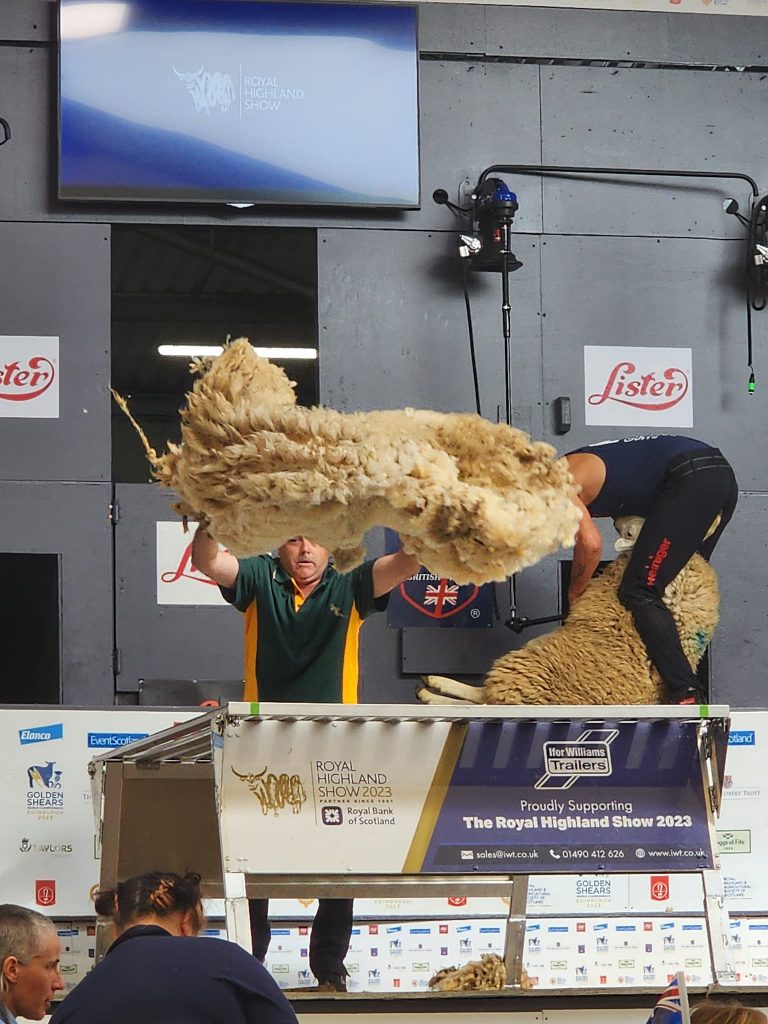
    1. The fleeces are to be thrown on a rectangular table by the back legs, having the head land at the head of the table.
    2. Judging starts when the competitor lets go of any part of the fleece.
    3. The position of the fleece as it has landed on the table.
    4. Final presentation of rolled fleece.                                                                                             (5 penalties max)
    5. FLC must be rolled not gathered, breech to neck, and placed neatly within the “designated area”
    6.   Table not clean between fleeces, before next fleece is thrown.
    7.   All wool handlers work area around the table and the oddment containers,   which includes, no overhang outside of oddment containers, must be clean between fleeces.                                                                                Except in teams events.
    8. Underneath the table must be completely swept clean for the final cleanup. But does not need to be swept clean between fleeces.
  6. Table work (refer to a, b, c, d, g,)                                                                                                                                                 i. Any wool of any type left outside the designated area, if not retrieved between the fleeces clean-up, will be continually penalised on each sequential fleece as long as it stays there.                                                                                          ii. Unauthorised piles. Will be judged on wool type. EG - SHK 10 penalties per CC.                                                             iii. Must use all available buckets before making an unauthorised pile.                                                                                      iv. If insufficient buckets and unauthorised piles made, competitor must let the floor judge know at completion of the heat/final.
  7. Final Clean up
    1. (i) Total Work Area Clean (Re. 14. b, c & d)
  1. Each fleece will be judged on any faulty fleece types or oddments left inside the rolled fleece.
  2. Each competitors’ fleeces will be numbered and/or colour coded to their table EG peg, coloured ribbon, gubba bag, pack, etc. (refer to b, c, d)
  1. Oddment container will be judged for any incorrect disposal. (Re. 14. b, c & d)
  2. A measured grid is recommended, for accurately calculating the faults.


  1. Floor Judges -
    1. The change judge will determine the commencement of the rotation at the completion of crutch area. Change judge to check counters and scores to be taken to the scorers. Example of number of judges on the board three (3) tables, four (4) judges to rotate.
    2. Teams’ event: Where there are two (2) wool handlers, two (2) shearers & one (1) table.
    3. At the end of each heat, judges will check for empty oddment container before scoring an unauthorised pile on the floor.
    4. Judge will show Competitors the counter at completion of heat/final and notify the competitor that this may not be the final recorded score
  2. Fleece Judges -
    1. EG one (1) table to three (3) judges to judge all fleeces. Fleeces will be numbered according to the Competitor’s stand or colour coded according to the Competitor’s stand and taken out the back when each fleece is completed.
    2. Score cards will remain with the Fleece Judge and counters to be taken to the designated Judge who will then be responsible for recording the results and returning the counters to zero (0).
    3. Faults/oddments from fleeces to be taken to the scorers.
  3. Oddment Judges
    1. EG one (1) table to three (3) tables, two (2) to three (3) judges to judge all oddments containers.
    2. Same oddment judges to judge through the same event from heats to finals.
    3. Judges must judge the same oddments for all competitors, . EG a judge must judge the PCS for all Competitor’s for the duration of the event.
    4. Oddments containers will be numbered or colour coded to the event.
    5. Faults from oddments to be taken to the scorers.
    6. A designated judge will be responsible for recording the results on the score sheet.
  1. Floor, Fleece and Oddment penalties are totaled and divided by the number of fleeces.
  2. These are then added to the time penalties and extra whole points.
  3. The competitor with the lowest points (score) total is the winner.

Wool handling and Judging language:

.

Board judging                                             is the judging of the competition work area which includes the shearing board, the                                                                         floor area and the wool table area.


Back judging                                               is the judging of the finished prepared wools. This is currently known as                                                                                           oddments, fleece judging, out the back judging, outside judging.


Grid                                                                is a tool used for wool assessment judging, that measures with dimensions of 10cm x 15cm (REC) rectangle and 5cm x 8cm (CC) credit card.

A4 Paper                                                      is a tool used for wool assessment judging, that measures dimensions of 30cm x 21cm (A4).


Split level shearing board                       is made up of a raised board where the shearing occurs, and the lower level wool                                                                            handling area which includes the wool table.


Bins                                                                are the receptacles used for oddments. Also known as bins, buckets, baskets or boxes.


Fleece Bins                                                  are the receptacles used for the fleece wool. Also known as wool packs, Gubba bags.


Broom/ board sweep                               is the tool used by Competitor’s to sweep or clean the competition area, also                                                                                   referred to as a paddle, board broom, blade broom. They can be either long or                                                                                  short.


Wool table                                                  is the competition table used by a competitor.


Oddments                                                   are all other wools excluding fleece wool. This includes, stain, dags, shanks, skin,                                                                          locks, crutch wool, pieces/skirtings, and bellies.


Stain (STN)                           Belly wool (BLS)                              Skin Pieces (SKN)

Shanks (SHK)                       Locks (LKS)                                       Pieces (PCS)

Black Wool (BLK)                Credit Card (CC)                              Rectangle (REC)

Jowl (JWL)


 Board Penalties/Points: Counters Back to Zero – CHECK

            Checked areas between the competitors, so you can see clearly

            Belly Left on the board

Clear belly before wool handler returns to table                                                                                              5 Penalties

(Belly must be cleared before wool handler returns to table)

Crutch Area                                                                                                                                                  REC/CC Penalties

(REC = 15cm by 10 cm rectangle / CC = 8cm by 5cm Credit Card)

Remove SHK, STN, DAG                                                                                                                                                10 CC

Remove LKS,  and short crutch wool                                                                                                                             2 CC

  Competitor’s must not get on board  (one foot to be on the floor at all times )                       5 Points

Hinderance                                                                                                                                                                   5 Points

(Point is subject only to inclusion and addition to the score – NOT added to counter)

Clean shearing board between fleeces                                                                                                    REC/CC Penalties

(REC = 15cm by 10cm rectangle / CC = 8cm by 5cm Credit Card)

Fleece types: PCS, BLS, FLEECE WOOL                                                                                                                      2 REC

Use of fleece to clear away locks on board                                                                                                            5 Penalties

Wool outside of Competitor’s space (per offence between fleeces)                                                            REC/CC

Failure to remove black wools when called by the competitors shearer                                                                 10 CC

No piles  outside oddment containers (Unauthorized piles)                                           REC/CC Penalties

Scoring wool that the fleece is placed on top of.                                                                        REC/CC Penalties

Leaving fleece on the board unattended                                                                                                  5 Penalties

Table Penalties/Points 

Throwing fleece on table (A4 = 30cm by 21cm rectangle)                                                    1 Penalty per A4 size

(Judging starts when one hand has been removed from fleece)

Presentation of Roll & placement                                                                                                                   5 Penalties max

(Fleece must be rolled not gathered,  breech to neck, and placed neatly within

the “designated area”)

Wool left on table before next fleece is thrown                                                                                         REC/CC Penalties

Sweeping work area between fleeces (except during team events)                                            REC/CC Penalties

(Work area = On top of and around table, from stage board to table, includes overhang of oddment containers – NOT under table)

            Competitor’s must not get on table (one foot to be on the floor at all times )                               5 Points


Board clean up penalties

All wool in containers at the end:                                                                                                        REC/CC Penalties

PCS, BLS and other Fleece wool                                                                                                                                2 REC

LKS,  and short crutch wool                                                                                                                                          2 CC

STN, SKN, SHK,  DAG, BLK                                                                                                                                        10 CC

End general tidy up                                                                                                                                                   REC/CC

Board general penalties/points

(A Penalty stroke is subject to further calculation i.e. addition and division)

Wool outside of Competitor’s space (per offence)                                                                          REC/CC Penalties

No piles  outside oddment containers (Unauthorized piles)                                                         REC/CC Penalties

Whole Points (Points is subject only to inclusion and addition to the score)

Hindrance                                                                                                                                                                  5 Points

Competitor on board or table as per rules     5 Points

Interference with wool after time                                                                                                                5 Points

Leaving their table before last competitor has completed                                                                                  5 Points


Wool assessment penalties

Inaccuracy of oddments                            GRID penalties                                                                           REC/CC

Inaccuracy of fleece                                   GRID penalties                                                                            REC/CC


Stain = STN                                           Belly Wool = BLS                                Skin Pieces = SKN

Shanks = SHK                                       Locks = LKS                                          Pieces/Skirtings’ = PCS

Black Wool = BLK                               Credit Card = CC                                Rectangle = REC

Jowl = JWL
 

Downloads

© 2026 Sports Shear • All Rights Reserved
Designed by Clutch Digital
linkedin facebook pinterest youtube rss twitter instagram facebook-blank rss-blank linkedin-blank pinterest youtube twitter instagram